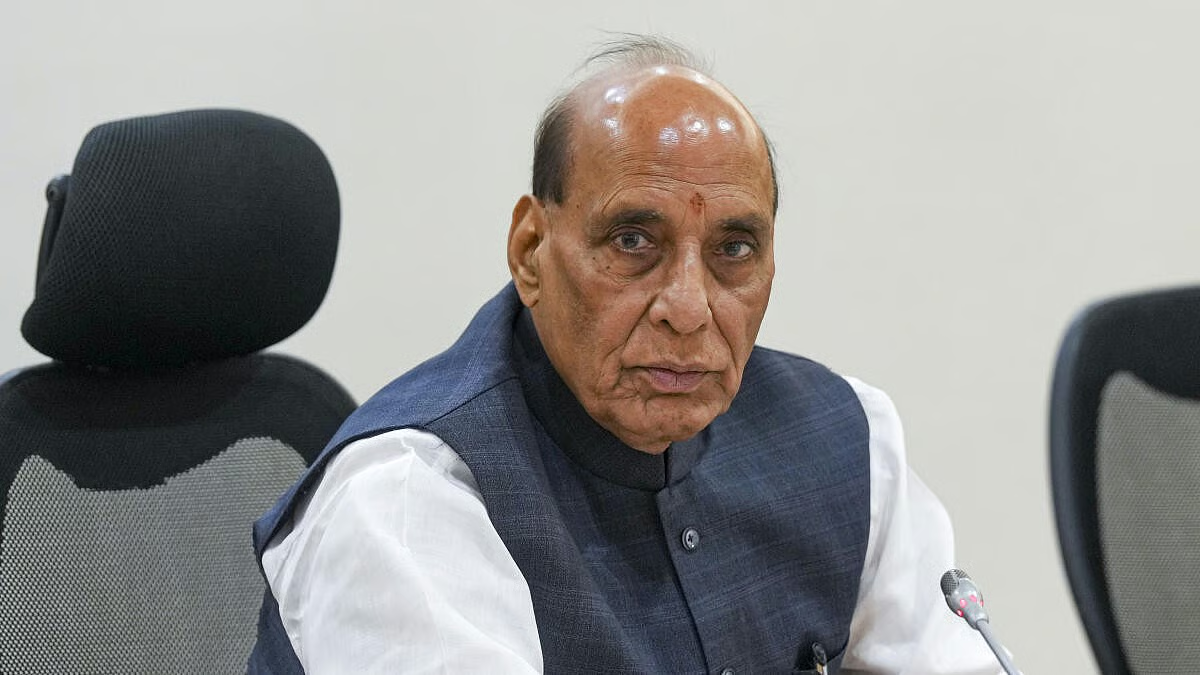
New Delhi | As 2025 draws to a close, India’s armed forces may receive a significant strategic boost with the Defence Acquisition Council (DAC) set to hold its final meeting of the year on December 26. The high-level meeting, chaired by Defence Minister Rajnath Singh, is expected to take crucial decisions on the emergency procurement of missiles, precision-guided munitions and advanced radar systems—moves that could further strengthen India’s defence posture amid ongoing tensions with China and Pakistan.
Officials indicated that the meeting will revisit several Emergency Procurement (EP) proposals that remained pending after the previous EP round concluded on November 19, 2025, while also considering new acquisition proposals. The urgency for faster inductions gained momentum following Operation Sindoor, which highlighted gaps in the timely availability of modern weapon systems.
Why Emergency Procurement Matters
Emergency Procurement is a special mechanism under the Ministry of Defence that allows quick acquisition of critical equipment during exigent operational situations or after major military operations. While the quantities procured under EP are limited, the process significantly shortens delivery timelines by bypassing prolonged procedural delays. Under this route, each system can be procured up to a financial limit of ₹300 crore, covering missiles, ammunition, small arms and anti-tank systems.
Navy Pushes for MR-SAM Missiles
The Indian Navy is expected to seek approval for the procurement of over 700 Medium Range Surface-to-Air Missiles (MR-SAMs). With an interception range of up to 70 km, these missiles can neutralise enemy fighter aircraft, helicopters, drones and incoming missiles. Developed jointly by DRDO and Israel Aerospace Industries (IAI) and manufactured by Bharat Dynamics Limited (BDL), MR-SAMs are already deployed on major naval platforms, but declining stock levels have necessitated fresh orders. The system is also in service with the Army and the Air Force, ensuring a common air defence framework across the three services.
IAF Eyes Astra Mk-2
The Indian Air Force (IAF) is likely to push for the acquisition of over 600 Astra Mk-2 air-to-air missiles. Classified as a Beyond Visual Range (BVR) missile, Astra Mk-2 boasts an extended strike range of nearly 200 km, significantly outperforming the currently deployed Astra Mk-1. Defence planners believe long-range air-to-air missiles will be decisive in future aerial warfare, allowing fighter jets to engage hostile targets while remaining within Indian airspace.

Spice Bombs and New Radars on the Table
In addition to missiles, the DAC is expected to consider orders for more than 300 SPICE precision-guided bomb kits, manufactured in Israel. These systems were successfully used during the Balakot air strikes in 2019 and have once again gained relevance following Operation Sindoor.
The Indian Army has also proposed the procurement of additional low-level and lightweight radar systems, including the indigenously developed Aslesha (3D) and Bharani (2D) radars built by Bharat Electronics Limited (BEL). These systems, integrated with the Akashteer Command and Reporting System, played a key role in enhancing battlefield surveillance during recent operations.
A Crucial Meeting Ahead
The DAC meeting will be attended by the Minister of State for Defence, the Chief of Defence Staff (CDS), the chiefs of the Army, Navy and Air Force, the Defence Secretary, and the DRDO Chairman. If the proposals receive approval on December 26, defence officials expect a rapid enhancement of India’s combat readiness over the coming months.
Analysts believe the decisions taken at this meeting could mark a major turning point for India’s defence preparedness—strengthening maritime security with MR-SAMs, air dominance with Astra Mk-2 missiles, and ground surveillance with advanced radars—sending a strong strategic message across the region.